
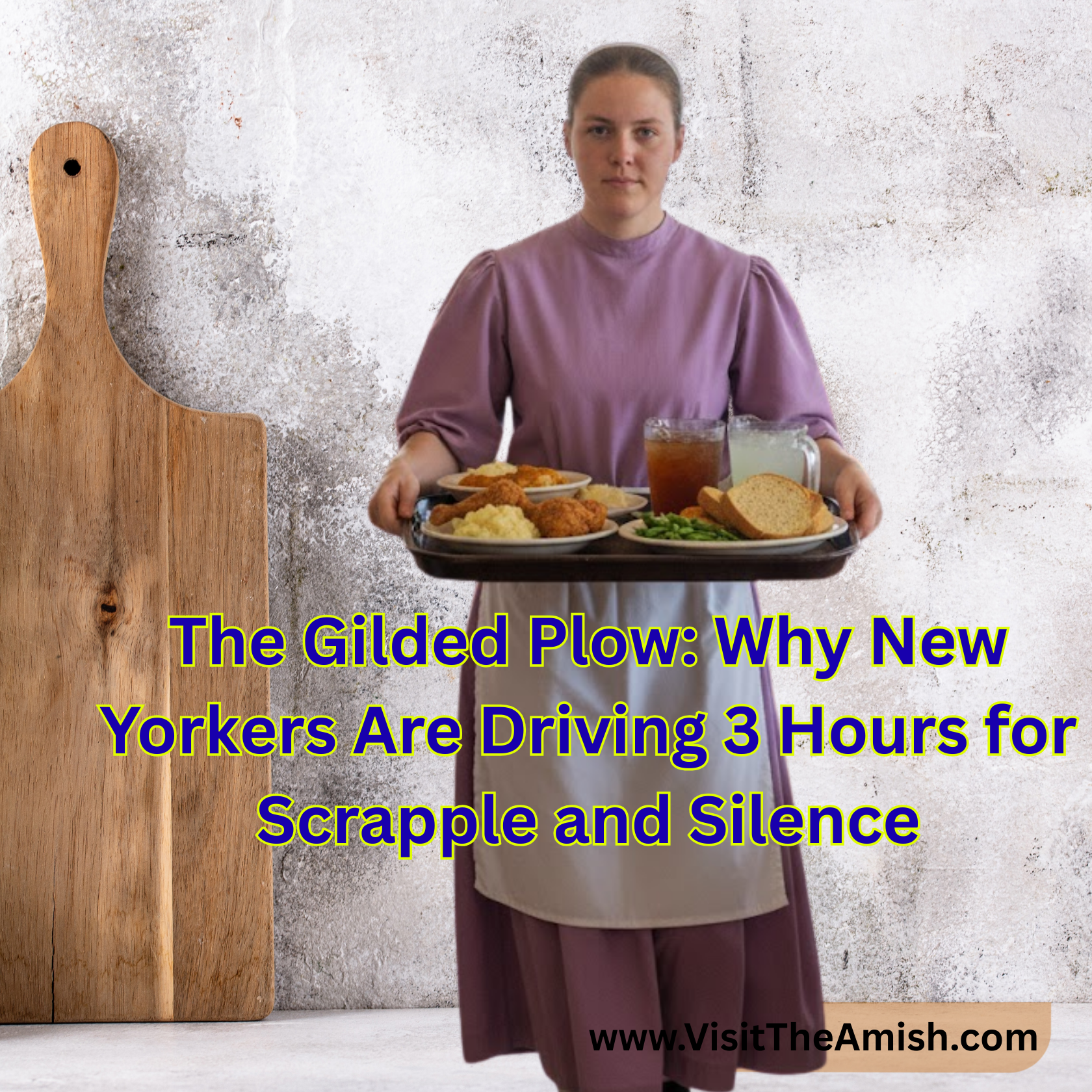
The Gilded Plow: Why New Yorkers Are Driving 3 Hours for Scrapple and Silence
By Elias Thorne | Food & Culture Editor
The first thing you notice isn’t the sign, because there isn’t one. The only indication that you have arrived at The Gilded Plow, the most talked-about restaurant in the Tri-State area, is the line. It snakes around the brick exterior of the renovated Knitting Mills on North 8th Street, a huddled mass of shivering Philadelphians, curious locals, and adventurous New Yorkers, all standing in the damp Reading mist.
They aren’t checking their phones. They can’t. A strict “digital fasting” policy is enforced at the door. Instead, they are doing something radical: they are talking to strangers, fueled by the scent wafting from the ventilation stacks—a heavy, intoxicating perfume of browned butter, woodsmoke, and yeast.
Reading, Pennsylvania, a city often defined by its industrial past and grit, is currently undergoing a culinary renaissance. But while other establishments are chasing foam emulsions and deconstructed plates, The Gilded Plow is sprinting in the opposite direction. It is an Amish-owned, gas-lit, communal-dining cathedral dedicated to the slow, deliberate art of Pennsylvania Dutch cookery.

A Step Back in Time
Entering The Gilded Plow is less like walking into a restaurant and more like stepping into a Vermeer painting. The cavernous industrial space has been softened by rough-hewn oak beams and whitewashed shiplap. There are no humming refrigerators (ice blocks are delivered daily) and no buzzing LEDs. The dining room, which seats 150, is illuminated entirely by intricate gas chandeliers and hundreds of beeswax candles.
“It takes your eyes about ten minutes to adjust,” says Caleb Yoder, the 28-year-old visionary behind the project. Yoder left his community for a brief stint in culinary school in rebellion, only to return with a newfound respect for his grandmother’s recipes. “When the eyes adjust, the ears do too. The noise level here is different. It’s softer. People whisper. They lean in.”
The furniture consists of massive, twenty-foot walnut tables. You don’t book a table; you book a seat. This means a banker from West Reading might be passing the chow-chow to a tattoo artist from Brooklyn.
The Menu: Heritage, Not Gimmick
The food at The Gilded Plow is not the lukewarm buffet fare often associated with tourist traps along Route 30. This is elevated farmhouse cuisine, prepared with an obsessive attention to provenance. Every vegetable is grown within twenty miles; the dairy comes from Yoder’s cousins in Lancaster County.
The menu changes daily, scrawled on a massive slate board near the kitchen, but the opening months have established a few “cult classics” that have food bloggers weeping into their napkins.
The Crowd Favorites
- The “Sunday Best” Roast Chicken: This is not deep-fried. It is slow-roasted in a cast-iron hearth over hickory coals, basted every ten minutes with a mixture of cultured butter, sage, and apple cider vinegar. The skin is like glass; the meat falls away from the bone if you look at it sternly.
- Saffron Pot Pie Noodles: A staple of PA Dutch cooking, here they are rolled by hand to a translucent thinness. Stained yellow with real saffron threads and simmered in a rich capon broth, they are served simply with cracked black pepper.
- The “Barn-Raising” Board: A charcuterie board on steroids. It features Lebanon bologna smoked for 48 hours, pickled red beet eggs that are surprisingly delicate, cup cheese (a viscous, sharp spread), and “souse” (head cheese) that Yoder has somehow made approachable and tender.
- Brown Butter Scrapple: Perhaps the most controversial item, Yoder serves his scrapple crisp-fried and topped with a poached duck egg and maple-mustard drizzle. It redeems the often-maligned breakfast meat, turning it into a savory, texture-rich delicacy.
THE GILDED PLOW
North 8th St. Knitting Mills • Reading, Penna.
Hearthside Provisions & Fellowship
We ask that all electronic devices remain stowed away so that we may better enjoy the company of our neighbors.
To Begin & Share
WARM MILK BREAD BOULE | 12 Baked hourly in the stone oven. Served with dark apple butter and cultured sea salt butter. THE “BARN-RAISING” BOARD | 32 48-hour smoked Lebanon bologna, tender souse (head cheese), aged cup cheese, house-pickled red beet eggs, coarse mustard, toasted rye. BROWN BUTTER SCRAPPLE | 16 Crisp-fried heritage pork scrapple, poached duck egg, maple-mustard drizzle, chives.The Seven Sweets & Sours
(Included with every supper. A traditional palate-cleansing interlude.)Chow-Chow • Pepper Cabbage • Spiced Cantaloupe Pickled Watermelon Rind • Rhubarb Jam • Red Beet Salad • Tart Applesauce
Supper From The Hearth
THE “SUNDAY BEST” ROAST CHICKEN | 38 Half chicken slow-roasted over hickory coals, basted with cider vinegar and sage butter. Served with roasted root vegetables and pan jus. SAFFRON POT PIE NOODLES | 30 Hand-rolled saffron egg noodles simmered in rich capon broth with shredded dark meat and cracked pepper. SCHNITZ UN KNEPP | 34 Smoked ham hock braised with dried sweet apples and hearty buttermilk dumplings. HEARTH-SEARED TROUT | 36 Local rainbow trout finished with brown butter, toasted almonds, and preserved lemon. Served over wilted dandelion greens.Sweet Endings
MOLASSES SHOOFLY TART | 14 Traditional “wet-bottom” style. Warm, gooey molasses custard beneath a spiced crumb topping. Served with unsweetened heavy cream. BAKED ROME BEAUTY APPLE DUMPLING | 12 Wrapped in flaky lard pastry, baked in cinnamon syrup, served in a pool of vanilla bean custard.Voices from the Table
The communal seating forces interaction, and the reviews are happening in real-time, face-to-face.
“I drove two hours for the bread,” says Marcus Vane, a 34-year-old software developer from Jersey City. He is referring to the Warm Milk Bread, served as a whole loaf for every four people, accompanied by a crock of apple butter so dark it looks like chocolate. “I honestly didn’t know bread could taste like this. It’s sweet, but not sugary. It tastes like… history? Is that pretentious to say? I don’t care. Pass the butter.”
Local reception, however, was initially skeptical. Reading residents are protective of their city and wary of gentrification.
“I thought it was going to be a theme park,” admits Sarah Detweiler, a retired schoolteacher who has lived in Reading for forty years. “We have plenty of diners. I didn’t see why we needed a fancy Amish place. But then I tried the Schnitz un Knepp (ham with dried apples and dumplings).” She pauses, gesturing to her empty plate. “It tastes exactly like my Aunt Miriam’s. Maybe better. Don’t tell Miriam. It’s respectful food. It’s not making fun of us.”

The “Seven Sweets and Seven Sours” Revival
One of the most unique aspects of the meal is the table setting. Before any main courses arrive, the “runners” (dressed in plain clothes, though not traditional Amish garb) bring out the Seven Sweets and Seven Sours.
In most modern homes, this tradition has vanished. At The Gilded Plow, it is the centerpiece. The layout includes pepper cabbage, chow-chow, pickled watermelon rind, spiced cantaloupe, apple sauce, red beet salad, and rhubarb jam. It creates a palate-cleansing rhythm to the meal—a bite of fatty pork, a bite of acid, a bite of sweet.
“The pickled watermelon rind is the sleeper hit,” says Executive Sous Chef Mary Stoltzfus. “People look at it like it’s alien, but once they try that crunch and the clove spice, they ask for jars to take home. We have to tell them, ‘No takeout, come back and see us.'”
The Sweetest Ending
Dessert is not optional at The Gilded Plow; it is a requirement. The undisputed star is the Molasses Shoofly Tart. Unlike the dry, cake-like versions found in grocery stores, this is a “wet-bottom” pie with a goo-to-crumb ratio that defies physics. It is served warm with a dollop of unsweetened heavy cream that cuts through the intense sweetness of the molasses.
For those who can’t handle the sugar rush of shoofly, there is the Baked Apple Dumpling. A whole Rome beauty apple, peeled and cored, wrapped in pastry, baked in cinnamon syrup, and served in a pool of vanilla bean custard.
The Verdict
The Gilded Plow is currently booked solid through February. Scalpers are reportedly selling “seats” on Reddit for triple the price. But beyond the hype, something important is happening at the old Knitting Mills.
In an era of UberEats and lonely desk lunches, Caleb Yoder has forced people to stop. The lack of electricity means you cannot see your food if you don’t pay attention to it. The lack of phones means you cannot ignore your neighbor.
“We aren’t selling food,” Yoder says, wiping his hands on a flour-dusted apron as the gas lamps flicker behind him. “We are selling fellowship. The schnitzel is just the excuse to get you to sit down.”
As I walked out into the cool Reading night, the smell of woodsmoke clinging to my coat, I reached for my phone to check my email. I looked at the black screen for a moment, then slid it back into my pocket. It could wait. I was still full of bread and silence.
“Wet-Bottom” Shoofly Tart
As served at The Gilded Plow. The secret is not overbaking it!
The Crust: 1 1/4 cups all-purpose flour 1/4 tsp salt 1/2 cup cold lard (or very cold butter), cubed 3-4 Tbsp ice water The Crumb Topping: 1 1/2 cups all-purpose flour 1/2 cup packed dark brown sugar 1 tsp cinnamon 1/2 tsp nutmeg 1/4 tsp cloves 1/4 cup cold butter, cubed The Molasses “Goo”: 3/4 cup robust molasses (not blackstrap) 3/4 cup boiling water 1 large egg, beaten well 1 tsp baking soda
Directions: Prepare the crust: Whisk flour and salt. Cut in cold lard with a pastry blender until it looks like coarse peas. Sprinkle ice water one tablespoon at a time, tossing with a fork until dough holds together. Do not overwork! Form into a disk, wrap, and chill for 30 mins. Roll out and fit into a 9-inch tart pan with a removable bottom. Prick the bottom with a fork. Heat the oven: Set to 400°F (200°C). Make the crumbs: In a medium bowl, whisk together flour, brown sugar, and spices. Cut in the cold butter using your fingers until the mixture looks like wet sand. Don’t melt the butter! Make the goo: In a large measuring cup, dissolve baking soda in the boiling water. Stir in the molasses. Let it cool slightly, then whisk in the beaten egg rapidly so it doesn’t scramble. Assembly (The tricky part!): Pour about one-third of the molasses liquid into the tart shell. Sprinkle one-third of the crumbs over it. Repeat layers, ending with a generous layer of crumbs on top. Do not stir! This layering creates the distinct “wet bottom” and “cake top.” Bake: Bake at 400°F for 10 minutes. Then, reduce heat to 350°F (175°C) and bake for another 25-30 minutes. The center should still jiggle slightly when you nudge the pan—it sets as it cools. Serve: Let cool completely before removing from the tart pan ring. Serve slightly warm with a dollop of heavy cream that you haven’t sweetened at all.
Enjoy the fellowship, my dear.