
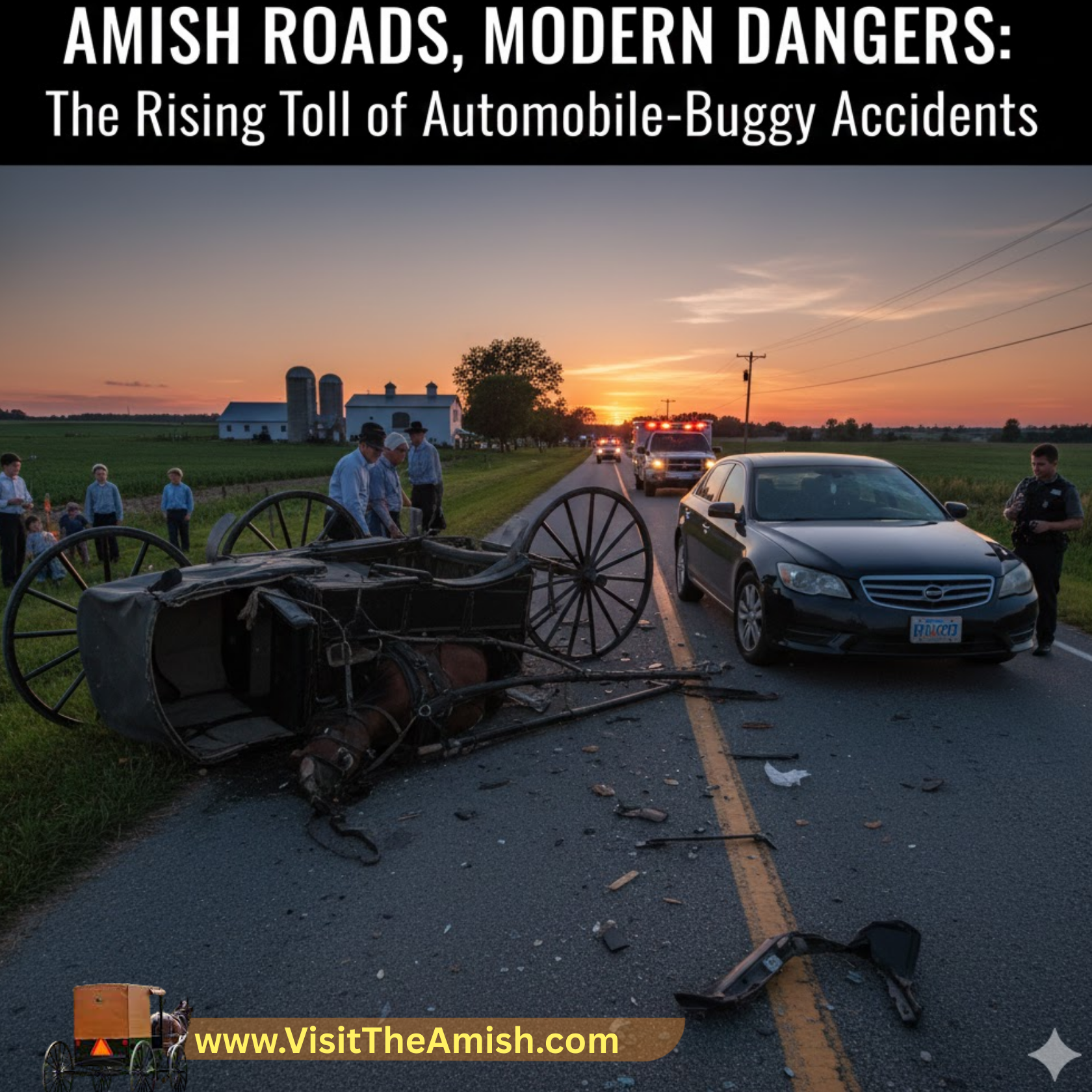
The two-lane roads of Amish country look peaceful, but the numbers behind them tell a more sobering story: crashes between cars and horse-drawn buggies are injuring and killing more people than many visitors realize. As tourism grows in places like Lancaster County, Pennsylvania, Holmes County, Ohio, and rural Michigan, the rising toll of automobile–buggy accidents has become an urgent safety concern for locals and travelers alike. Understanding the risks—and how to drive differently in these regions—is now part of being a responsible visitor.aldlawfirm+3
A Hidden Crisis on Quiet Rural Roads
In Pennsylvania alone, transportation data show more than 630 crashes involving horses and buggies from 2007 to 2016, resulting in at least 23 deaths and likely hundreds of injuries. One legal review noted over 625 buggy-related car accidents since 2007, with “hundreds of injuries” and at least 20 fatalities in the state. Ohio officials estimate around 120 buggy accidents occur in that state every year, underscoring that this is not an isolated Pennsylvania problem but a multi-state pattern across Amish regions.elkandelk+2
Michigan, which has smaller but growing Amish settlements, recorded 137 buggy-involved crashes from 2014 to 2018, with eight deaths and 46 injuries in that five-year span. These figures are small compared with overall traffic volumes, but each incident carries a high risk of severe injury because a lightweight buggy offers almost no protection against a car or truck. For visitors expecting tranquil countryside, the reality is that some of the region’s most picturesque byways are also among the most unforgiving when speeds and distractions climb.lansingstatejournal+1
Why Amish Buggies Are So Vulnerable
Tourists often underestimate the closing speed between a modern vehicle and a horse-drawn buggy traveling at 5 to 10 miles per hour. Pennsylvania safety officials point out that curvy roads, hills, and poor passing decisions routinely contribute to crashes, especially when drivers top a rise and suddenly encounter a slow-moving buggy just ahead. In many cases, agencies note that motorists—not buggy drivers—bear the primary blame, with speeding and distracted driving frequently cited as factors.amishamerica+2
Data and safety experts also stress that crash severity is disproportionately high for buggy occupants. A typical Amish buggy lacks airbags, crumple zones, and seatbelts, and collisions can throw passengers out or cause the carriage to overturn. A Michigan analysis found that buggy crashes were often classified similarly to pedestrian incidents because of how unprotected the occupants are, emphasizing their vulnerability in any collision with a motor vehicle.pubmed.ncbi.nlm.nih+2
How States Are Responding
Recognizing the trend, states with large Amish populations have begun investing in infrastructure and policy changes aimed at reducing these crashes. In Ohio, the Department of Transportation reported around 120 buggy accidents annually and secured a federal grant of about $9.6 million to improve safety for Amish travelers. Planned measures include widening shoulders, posting more warning signs, adding buggy lanes where possible, and installing sensors that detect buggies and alert oncoming traffic.transportation.ohio+2
Pennsylvania has focused heavily on education and collaboration with Amish leaders. Safety advocates there helped create a dedicated “Horse and Buggy Drivers Manual,” which officials say is now widely distributed in Lancaster County and used to teach best practices for operating buggies on modern roads. Traffic engineers in Michigan, learning from experience in Pennsylvania and Ohio, have studied these approaches as they consider shoulder improvements, vegetation trimming for better sightlines, and targeted public awareness campaigns.ydr+1
What This Means for Travelers
For tourists, the takeaway is clear: driving in Amish country is not business as usual. State safety officers and travel resources repeatedly emphasize a few key habits—slowing down on hills and curves, avoiding tailgating, giving extra space when passing, and treating buggies as you would cyclists or farm equipment. Many agencies warn that trying to squeeze past a buggy just before a hill or blind turn is one of the most dangerous—and sadly common—choices drivers make.dispatch+2
Visitors also need to understand that buggy lighting and reflective markings vary among Amish and related communities, especially at night. Some groups embrace reflective triangles and LED lighting; others are more cautious about adopting visible modern features, which can make buggies harder to spot at dusk or in poor weather. For a tourist editor, the message to readers is simple but urgent: if you’re enjoying the charm of an Amish region, you owe the local families the courtesy of fully attentive, patient driving.lansingstatejournal+1
The Growing Tourism–Safety Balance
Millions of non-Amish drivers now share roads with more than 76,000 Amish and Mennonite travelers in certain states, according to reporting on Amish transportation. Tourism boards promote these communities for their markets, restaurants, and scenery, but each additional rental car and tour bus increases the complexity of the shared road environment. At the same time, crash compilations tracking buggy incidents year after year show that the problem has not gone away—and in some areas appears to be stubbornly persistent.mapministry+2
For visitors, this means that appreciating the beauty of a buggy on a country lane comes with responsibility. A single distracted moment can have devastating consequences for an Amish family whose only misstep was being in the wrong place when a driver looked down at a phone. Travel writers, tour operators, and local visitor bureaus increasingly weave safety reminders into guides, hoping to ensure that picturesque drives stay safe for everyone who calls these backroads home.ydr+3
- https://aldlawfirm.com/hundreds-of-injuries-from-horse-and-buggy-crashes-in-pennsylvania/
- https://www.elkandelk.com/ohio-taking-steps-to-protect-amish-buggies/
- https://www.ydr.com/story/news/2018/02/02/penndot-23-people-have-died-hundreds-injured-5-12-06-daily-record-sunday-news-bil-bowden-horse-and-b/1083950001/
- https://www.lansingstatejournal.com/story/news/local/2019/09/20/driving-roads-amish-horse-drawn-buggies-safety-michigan-pennsylvania-ohio/2385087001/
- https://pubmed.ncbi.nlm.nih.gov/15055846/
- https://amishamerica.com/over-600-pennsylvania-buggy-accidents-since-2003/
- https://www.transportation.ohio.gov/wps/wcm/connect/gov/2c525741-56f1-4a3a-96a2-b95ccff2689c/HistoricCrashData.pdf?MOD=AJPERES&CONVERT_TO=url&CACHEID=ROOTWORKSPACE.Z18_K9I401S01H7F40QBNJU3SO1F56-2c525741-56f1-4a3a-96a2-b95ccff2689c-nAkqB-M
- https://www.dispatch.com/story/news/2020/07/15/amish-buggy-collisions-with-cars-trucks-how-can-ohio-roads-be-safer/112742094/
- https://www.mapministry.org/news-and-stories/amish-buggy-accidents-2025-page-1
- https://www.facebook.com/groups/OurColdwater/posts/3558976504397564/