
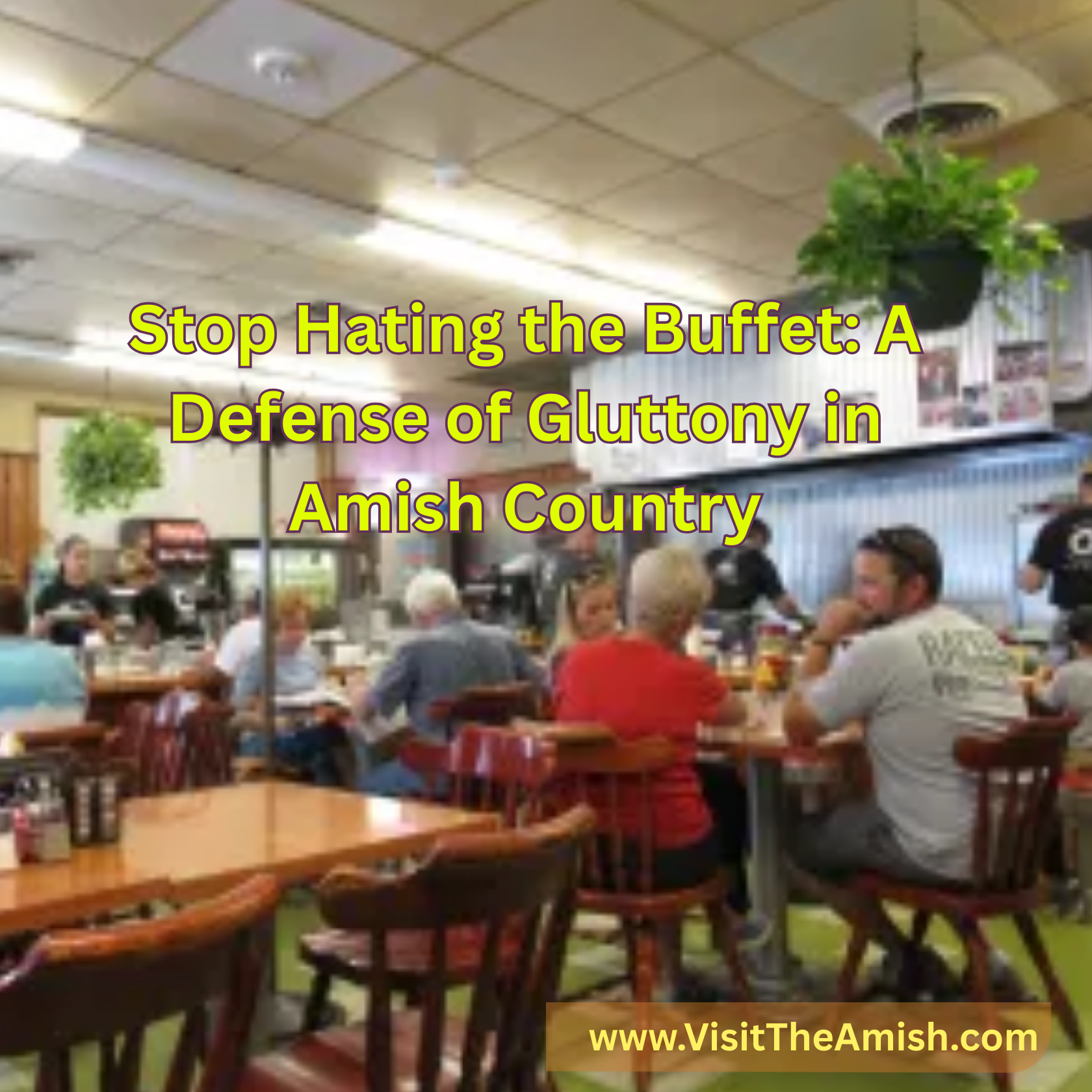
There is a specific genre of criticism reserved for the Amish buffet. It is a mixture of fascination and revulsion, usually espoused by food purists who view these establishments as culinary crimes scenes.
The narrative goes like this: The buffet is where culinary dreams go to die. It is a place where quality is sacrificed on the altar of quantity, where busloads of tourists descend to gorge on unlimited fried chicken and mashed potatoes, and where the “Plain People”—known for their modesty and rejection of worldly vanity—engage in the most ostentatious display of commercial gluttony imaginable.
Critics often point to the optics. One local food writer in Lancaster recently lamented the scene, describing it as a frightening parade of “obese people with walkers” shuffling toward the carving station for one last slice of ham. The argument is that these carbohydrate cathedrals are hypocritical traps, luring the “English” (non-Amish) in with the promise of heritage but delivering only industrial-scale calories.
I used to subscribe to this snobbery. My plan for navigating Pennsylvania Dutch Country was to strictly avoid the troughs. I would seek out the hidden gems, the places where the locals actually ate, and leave the smorgasbords to the tour buses.
But after a recent trip to the rolling hills of Reading and Lancaster, I’ve had to ask myself: Is the Amish buffet actually evil, or are we just being prudish?

The “Real” Food Alternative
To test my hypothesis that smaller is better, I skipped the famous Good ‘N Plenty—where Yelp reviewers frequently complain about the awkwardness of communal seating—and headed for a local legend: Town Hall Restaurant in Blue Ball, PA.
Town Hall is the antithesis of the tourist trap. It is a modest diner wedged into the side of a volunteer firehouse, run by the same family for over half a century. The rumor mill suggested this is where buffet employees go when they want a meal they didn’t have to cook in 50-gallon drums.
The rumor mill was right. The food at Town Hall wasn’t just authentic; it was a revelation. I ordered the Stuffed Pig’s Stomach (Hog Maw), a regional delicacy that scares off the uninitiated but delights the faithful. Think of it as a Pennsylvania Dutch haggis or a gigantic sausage without the casing—savory pork, potatoes, and spices roasted to perfection. Served alongside corn fritters and a crisp cucumber slaw, it was a meal that made my eyes roll back in my head.
I even managed to buy a staff T-shirt with their slogan: “Quality AND Quantity.” It felt like a victory for the “slow food” movement. I had found the real deal.
The Spectacle of Shady Maple
However, curiosity is a powerful thing. Before we sat down at the humble Town Hall, we took a detour to witness the beast itself: The Shady Maple Smorgasbord.
To call Shady Maple a “restaurant” is a disservice; it is a compound. It features a supermarket the size of a stadium, a furniture store, and a gift shop that seems to stretch into infinity. And then, there is the buffet.
Entering the Shady Maple complex, the “simple life” is the last thing on your mind. The portico is massive, reminiscent of a Las Vegas casino entrance. Inside, the aesthetic is a confusing mix of opulence and kitsch—ornamental carpets, oversized armchairs, and 3-D artwork of buggies.
Through the windows, we saw them: the diners. Rows upon rows of long tables stretching toward the horizon, a sea of humanity engaged in the act of consumption. A line of hungry patrons snaked through the lobby, willing to wait 45 minutes for the privilege of entry. At the time, I snickered. I felt superior. I turned around and drove to the firehouse diner.

Checking Our Hypocrisy at the Door
But in the days since, that snicker has haunted me. Why do we judge the Amish for building a successful business?
When we go to Las Vegas, we view the “All-You-Can-Eat” buffet as a challenge. We high-five each other for eating our weight in crab legs. We try to “beat the house” by consuming more value than the cover charge. Yet, when the Amish do it—offering a dinner price point around $20—we call it grotesque.
There is a subtle form of prejudice in wanting the Amish to remain frozen in time for our amusement. We want them to be quaint. We want them to sell jams from a roadside stand and stay in their buggies so we can take photos of them as we drive by in our air-conditioned SUVs. When they prove to be shrewd capitalists, building a commercial empire that funds their lifestyle, it rankles us. It breaks the diorama.
But there is no evidence that the Amish are abandoning their faith. They are simply adapting their economy. If selling unlimited shoofly pie to tourists allows them to maintain their farms and their community standards, who are we to judge the transaction?
The Verdict
I have realized that my aversion to the mega-buffet wasn’t about the food; it was about my own desire for “authenticity.” But Shady Maple is authentic. It is an authentic expression of modern Amish commerce meeting modern American appetite.
So, I am planning a return trip. I have a new itinerary. I’m going to hit the Green Dragon Farmer’s Market on a Friday, and then I am going to Shady Maple. In fact, I’m planning it around my birthday, because—like a true Vegas casino—the house gives you a free meal on your birthday if you bring a paying friend.
I’m done being a buffet snob. The stuffed pig’s stomach at the firehouse was incredible, but sometimes, you just want to see the spectacle. If the fried chicken is hot and the pie is plentiful, I say: let’s eat.
