
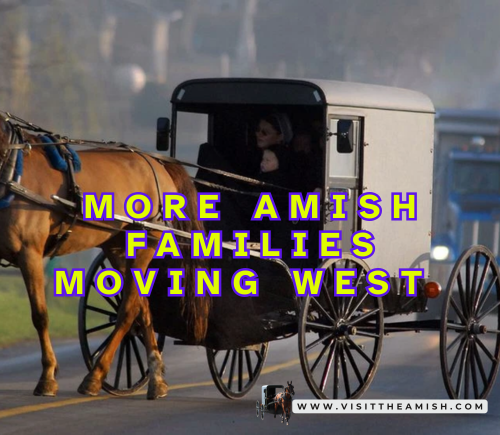
More Amish Families Moving West as Pennsylvania Population Reaches Record Highs
By Visit the Amish Editorial Staff
Updated November 2025
Pennsylvania’s Amish population has reached a historic milestone, driving quiet but significant migration across the state. As farmland becomes scarce in Lancaster County—the nation’s largest Amish community—many families are seeking new opportunities farther west. Researchers at Elizabethtown College’s Young Center for Anabaptist and Pietist Studies say these moves are part of a generational shift shaping the future of Amish life in Pennsylvania.
Record Growth in Lancaster’s Amish Settlement
The Lancaster settlement remains the largest Amish community in North America, home to roughly 44,000 Amish adults and children. Unlike traditional boundaries of counties or boroughs, the Amish define their settlements by church districts—smaller congregations that together form the heart of their religious and social life. There are now 267 Amish church districts in what researchers identify as the Lancaster settlement.
“The Amish double in size about every 20 years,” said Amish scholar Dr. Kyle Kopko of Elizabethtown College. “It’s growing fast.” Meanwhile, Dr. Steven Nolt, professor of history and director at the Young Center, noted that roughly 12 percent of the Lancaster settlement has expanded beyond the county’s borders, spilling into neighboring Chester, Dauphin, and Berks Counties, and even into northern Maryland.
Why Amish Families Are Heading West
For generations, the Amish viewed farm ownership as the cornerstone of faith, family, and independence. But as their population grows, farmland in Lancaster County has become scarce and expensive. The result is a quiet but steady westward migration.
“It’s not that farming families are giving up agriculture,” Nolt explained. “There are simply not enough farms to buy when each generation doubles in size.”
In the 20th century, nine out of ten Amish families farmed. Today, about one-third still do. And while there are technically more Amish-owned farms now than ever before, the growth of the population means a much smaller percentage can farm full-time. Many have turned to trades, construction, woodworking, and entrepreneurship to sustain their livelihoods.
New Settlements Near Littlestown and Beyond
In Adams County, the town of Littlestown is seeing new Amish families establish roots just beyond the borough limits. Mayor Jennifer Beskid said the community has welcomed these newcomers enthusiastically.
“We’ve seen an increase in Amish families purchasing farms and starting businesses,” Beskid said. “Pennland Greenhouse and King’s Farmstead and Market have become part of our local economy.”
While there were initial concerns about horse and buggy traffic, local leaders and Amish residents resolved issues through open communication. “The community adjusted quickly,” she noted. “Today, most residents appreciate having well-kept farmland and local markets close to home.”
A Shift Toward Business and Community Engagement
Amish entrepreneurship is also on the rise. Kopko, who now heads the County Commissioners Association of Pennsylvania, said he has seen growing numbers of Amish-run small businesses participating in state programs for tax credits and local business grants.
“Younger Amish families are more willing to engage with non-Amish business practices,” Kopko said. “They work side by side with their English neighbors and are practical about using tools that support their livelihoods.”
This trend is especially visible in Lancaster County, where economic diversity and land scarcity encourage Amish business ownership. Furniture shops, bakeries, greenhouses, and handmade goods markets have become fixtures of the region’s economy.
Economic Impacts and Common Misconceptions
The Amish contribute substantially to Pennsylvania’s local economies, often in ways that go unnoticed. Every farm sale or business purchase generates revenue through property and transfer taxes. Yet, their children attend private Amish schools, reducing strain on public education budgets.
“They create a net economic benefit,” Kopko explained. “Amish families are paying their share without using many public services.”
He also addressed lingering misconceptions. “They’re not uneducated or old-fashioned in the way people think,” he said. “They’re resourceful, skilled entrepreneurs with growing economic influence.”
The Future of Pennsylvania’s Amish Map
Amish migration westward is not an exodus—it’s an evolution. As younger families start anew in more rural counties, they carry with them the traditions, work ethic, and faith that have defined Amish life for centuries. Farmland stewardship remains central, but the Amish story continues to expand beyond its Lancaster roots into a modern, statewide presence.
For many observers, the biggest takeaway is not the movement itself, but the resilience it represents. In every barn raising, quilt shop, and roadside bakery, the values remain the same: community, humility, and a commitment to honest work.
As Kopko summed up, “Their communities are growing, thriving, and adapting—all while staying true to who they are.”
Related Reading:

