
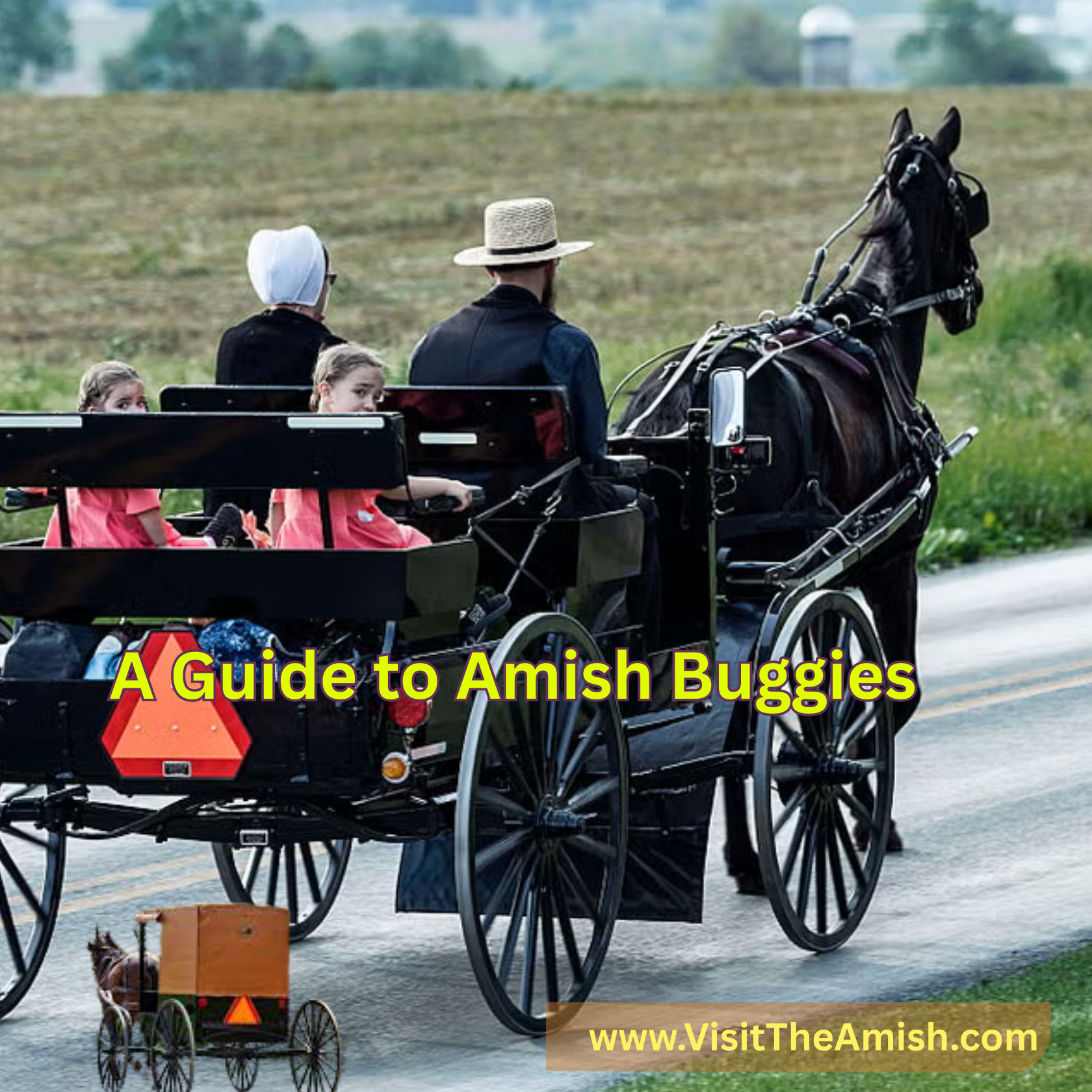
The Secret Language of the Road: A Guide to Amish Buggies
When you visit Amish country, the rhythmic clop-clop of hooves on pavement is the first sign that you have entered a different world. While the horse-drawn carriage is the universal symbol of the Amish refusal to be “yoked” with the modern world, not all buggies are created equal.1
To the untrained eye, they may all look like simple black boxes. However, the shape, style, and specifically the color of the buggy top act as a subtle code. These differences tell a story about where the driver is from, which specific church affiliation they belong to, and how conservative their community is.
Here is a detailed guide to the different kinds and colors of Amish buggies.
The Anatomy of a Buggy
Before diving into colors, it is important to understand the three main physical styles of carriages you will see on the road:
- The Family Buggy (Market Wagon): This is the standard enclosed carriage. It usually features a boxy shape, a roof, and four wheels. It is designed to carry parents and children, or groceries and supplies.2
- The Courting Buggy: Often open-fronted and single-seated (no roof or a convertible top), these are lighter and faster. They are driven by young, unmarried Amish men.
- The Spring Wagon (Hack): These are open vehicles with two or three bench seats, resembling a pickup truck bed. They are used for short trips, hauling light loads, or transporting larger groups to church.
Decoding the Colors
The color of the buggy “top” (the fabric covering the roof and sides) is the primary identifier of a specific Amish group.
1. The Gray Top
If you are visiting Lancaster County, Pennsylvania, you are seeing gray buggies.

- Who uses them: The Lancaster County Old Order Amish.
- The Look: These buggies are distinct because they are not boxy; they have a rounded, barrel-shaped roof. The fabric is a gray vinyl.
- Why: Lancaster is the oldest and one of the largest Amish settlements.3 Their unique gray tops and rounded bodies make them instantly recognizable from other groups.
2. The Black Top
This is the most common color found across North America.
- Who uses them: The vast majority of Amish in the Midwest (Ohio, Indiana, Iowa, Missouri) and many conservative groups in Pennsylvania.
- The Look: These are typically boxier than the Lancaster style, with a flat, vertical back and straight sides.
- Variations:
- Old Order (Midwest): Standard black box, usually with windshields and sliding doors.
- Swartzentruber Amish: The most ultra-conservative group. Their black buggies have no windshields, no sliding doors (using roll-up curtains instead), and use steel wheels rather than rubber-lined wheels.
- Buchanan Amish: Found in Iowa, they use a distinct “slope-backed” black buggy.

3. The Brown Top
This is a rare color specific to a small geographic region.
- Who uses them: The Old Order Amish of New Wilmington (Lawrence County), Pennsylvania.4
- The Look: Similar in shape to the Midwest black buggy, but covered in a distinct brown canvas or vinyl.
- Distinct Feature: These buggies often feature a “rollup” side rather than a sliding door and are known for being very traditional.
4. The White Top
Perhaps the most visually striking, these buggies stand out sharply against the rural landscape.

- Who uses them: The Nebraska Amish (also known as the “White Top” Amish), primarily located in Big Valley (Mifflin County), Pennsylvania.
- The Look: These buggies are very primitive. They often lack the “box” structure of other buggies. The white canvas top is stretched over a wooden frame, and the sides are often left open or covered with rough cloth.
- Why White? It is not for style; it is simply un-dyed canvas, reflecting a commitment to extreme simplicity and lower cost.
5. The Yellow Top
Another unique splash of color found in Pennsylvania.

- Who uses them: The Byler Amish (also known as the “Yellow Top” Amish), also found in Big Valley, Pennsylvania.5
- The Look: Similar in shape to the standard box buggy, but the roof is covered in a mustard-yellow fabric.
- Context: The Byler Amish are distinct from the Nebraska Amish (White tops) and the Renno Amish (Black tops), all of whom coexist in the same valley. The colors help maintain community boundaries.
Comparison: At A Glance
| Buggy Color | Primary Location | Group Affiliation | Key Feature |
| Gray | Lancaster, PA | Old Order (Lancaster) | Rounded/Barrel roof |
| Black | OH, IN, MI, PA | General Old Order | Boxy shape, most common |
| Black | Various (OH, TN, NY) | Swartzentruber | No windshield, steel wheels |
| Brown | Lawrence County, PA | New Wilmington | Brown canvas, very traditional |
| White | Mifflin County, PA | Nebraska Amish | Un-dyed canvas, open sides |
| Yellow | Mifflin County, PA | Byler Amish | Mustard yellow top |
Safety and Technology Indicators
Beyond color, the equipment on the buggy reveals the group’s stance on technology.
The SMV Triangle: Most states require the orange Slow Moving Vehicle triangle on the back of buggies. However, the Swartzentruber and Nebraska Amish often refuse to use them, arguing that the bright orange color is too flashy and that they should rely on God for protection, not government regulations. They use gray reflective tape and lanterns instead.
Lights and Blinkers: Progressive Amish groups (like those in Northern Indiana or Lancaster) often equip buggies with battery-operated LED turn signals and headlights. Conservative groups rely strictly on oil lanterns or non-electric reflectors.

These buggies pictured above are very traditional black, seen in Hardin County, Ohio. Almost 80 percent of all Amish buggies are black.